Magnetic Jewelry Factory or Trading Company? A B2B Verification Guide
RainSo is an in-house magnetic jewelry manufacturer and B2B supplier established in 2007. Its commercial team is based in Guangzhou, with production resources in Dongguan. The company also publishes ISO 9001 Certified wording. Its public catalog covers bracelets, rings, necklaces, earrings, and anklets in 316L stainless steel, copper, titanium, and ceramic.
The factory-or-trading question is straightforward: who controls production, who signs off quality control, and who can produce the records?
This guide gives you a six-part verification sequence and explains what RainSo can show for each point. The distinction separates verifiable evidence from claims that sound impressive but prove little.
Related reading: About RainSo | RainSo’s seven-step QC process | ISO 9001 quality management standard
On this page
Why the Magnetic Jewelry Factory or Trading Company Question Matters
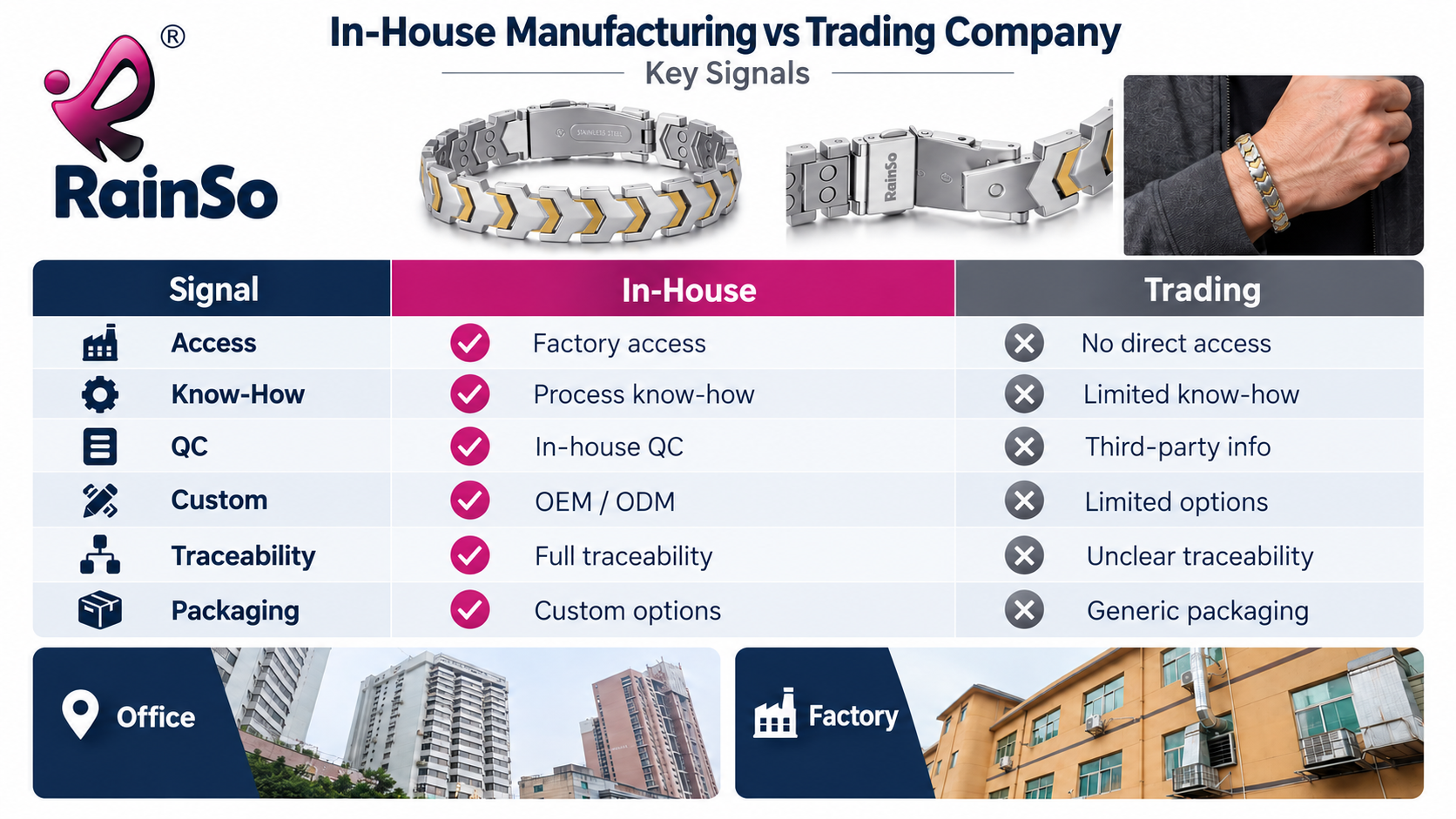
A trading company can offer a wider catalog and lower overhead because it works through partner factories. An in-house manufacturer may cover a narrower range but can usually control process changes, samples, and QC more directly. Neither model is automatically better. The difference becomes material when a problem appears and the buyer needs someone with direct access to production.
Magnetic jewelry makes that difference easier to test. Magnet placement, clasp function, finish consistency, and batch records all depend on production control. A supplier that cannot identify who owns those checks may still sell good products, but the buyer has less ability to verify how the order will be handled.
| Verification signal | In-house manufacturer | Trading company | What to ask |
|---|---|---|---|
| Production access | Direct access when the SKU runs through in-house production resources | Access depends on the partner factory and order scope | Which site will make this SKU, and who owns the process? |
| QC ownership | A named internal QC process may be used and documented | QC may be coordinated through a third-party factory | Who checks the batch before release, and what record is kept? |
| Custom development | Changes can move directly between the buyer, production, and sampling | Development is managed through the selected factory | Who controls CAD, tooling, samples, and final approval? |
| Traceability | Sample, batch, and QC references may sit closer to production | Records often remain with the factory rather than the trading office | Who can retrieve the records that match my order? |
| Product range | Usually focused on defined categories and materials | Often broader because sourcing is not limited to one line | Does the SKU fit current capability, or is it sourced elsewhere? |
| Certification scope | The certificate can be checked against the manufacturing entity and activity | The applicable scope depends on which company or factory holds it | Which legal entity and activity does the certificate cover? |
A Six-Part Verification Checklist for Any Supplier
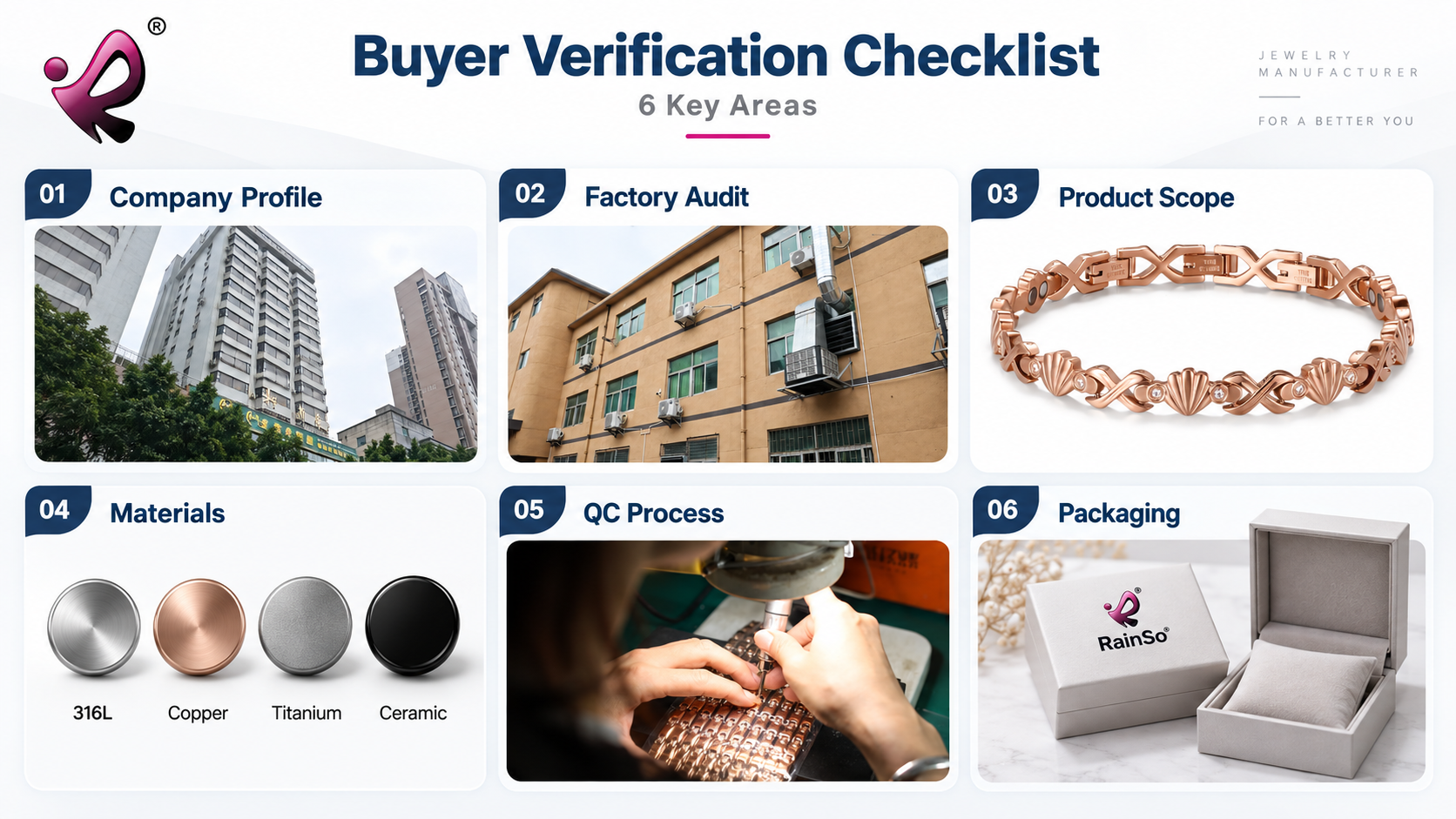
Use the list as a conversation sequence. A credible answer usually points to a document, a production contact, or a detail that can be checked later. A polished profile is a starting point; the order itself is where the real answers appear.
1. Company profile and registered scope
Start with the legal entity, year established, business scope, and the activity it is registered to carry out. In many jurisdictions, a manufacturing scope includes processing, production, or assembly. A trading scope may list wholesale, import, export, or distribution. That information tells you who you are dealing with. It still does not show who runs the production line.
2. Factory access and production resources
Start with a simple question: where will this exact order be produced? Then find out who signs off QC before shipment. It also helps to know whether a factory visit, live video call, or recent floor photos can be arranged. For RainSo, the public company information identifies a Guangzhou commercial team and production resources in Dongguan.
3. Product scope and material fit
Match the supplier’s actual product range to the category and material in your brief. For RainSo, the published range covers bracelets, rings, necklaces, earrings, and anklets. Published material families are 316L stainless steel, copper, titanium, and ceramic. Availability still comes down to the SKU and order.
4. QC process and inspection records
The useful answer is more than a general quality promise. It should identify the inspection points, how results are recorded, and who releases the batch. A documented process connects the check to the product, order, or batch.
5. Sample, batch, and packaging traceability
Traceability becomes concrete in three places: the approved sample, the production or material record, and the final packing specification. This matters most for custom work and repeat orders because it shows whether the next shipment is being compared with the same reference.
6. Certification scope and public claims
Every certificate has an edge: entity, activity, location, and validity. Those details are what make it useful. Public quality claims should be read the same way.
| Verification point | What to request | RainSo public position |
|---|---|---|
| Company profile | Registered identity and business scope | Established in 2007; Guangzhou commercial team; in-house manufacturer positioning |
| Production access | Production location, QC owner, audit route | Production resources in Dongguan, China |
| Product scope | Current categories and material families | Bracelets, rings, necklaces, earrings, and anklets; 316L stainless steel, copper, titanium, and ceramic |
| QC process | Checklist and inspection records | Published seven-step QC process |
| Traceability | Sample, batch, and packing references | Stock and custom order paths with project-level confirmation |
| Certification | Current certificate and covered scope | ISO 9001 Certified public wording |
What RainSo Confirms About Its Structure
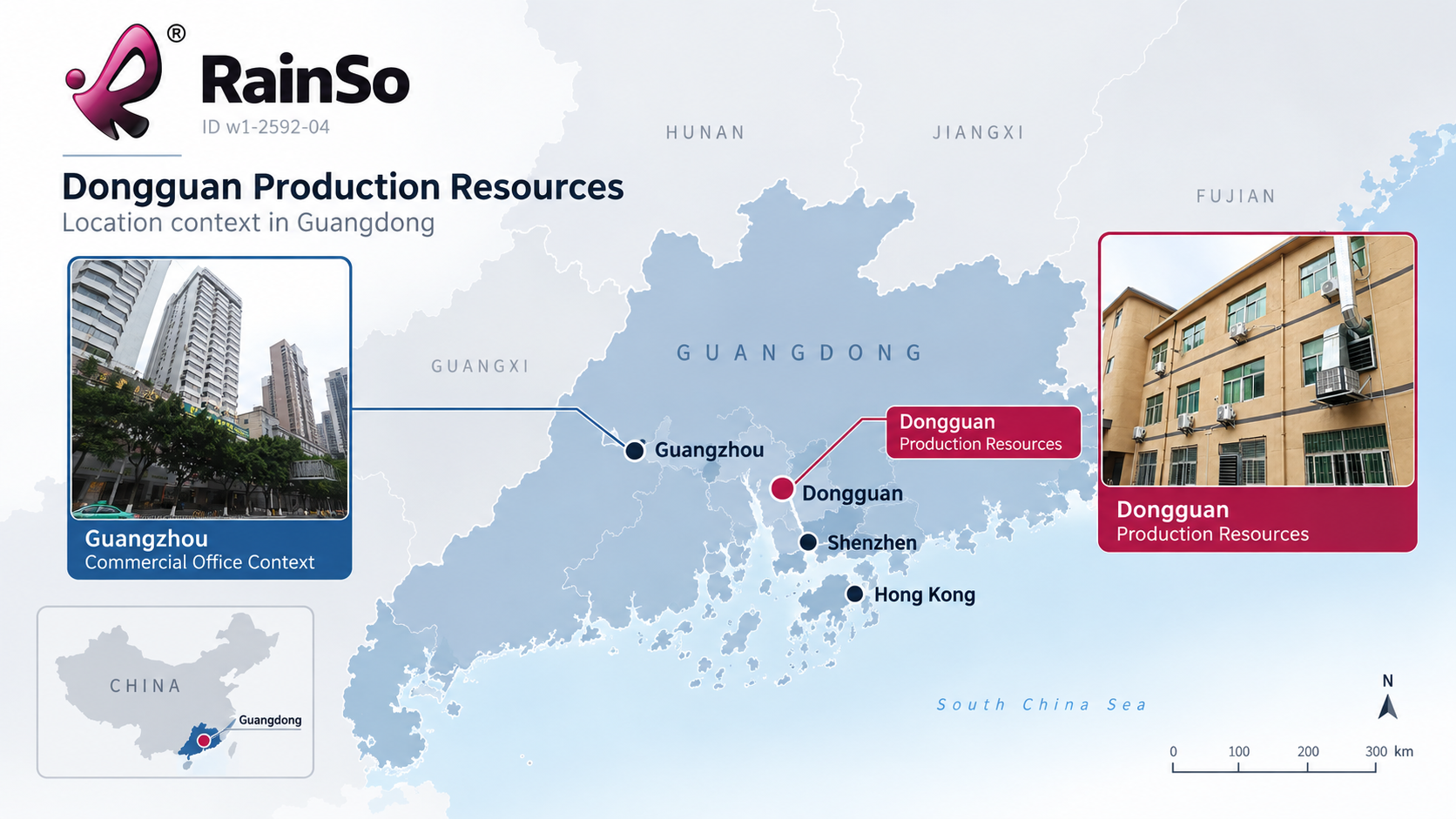
RainSo was established in 2007 and identifies itself as an in-house magnetic jewelry manufacturer and B2B supplier. The commercial team works from Guangzhou, while production resources are in Dongguan, China. That split is common: the commercial team handles communication, product planning, and support; the production side handles manufacturing and QC coordination.
Now put that structure against a live order. Who will run it? Which QC checks apply? How will the batch be traced? With an in-house structure, buyers can usually direct those questions to the teams responsible for production and QC. A trading company may need to obtain the same information from its partner factory. The difference affects how directly a buyer can get an answer.
What RainSo’s 7-Step QC Process Should Prove
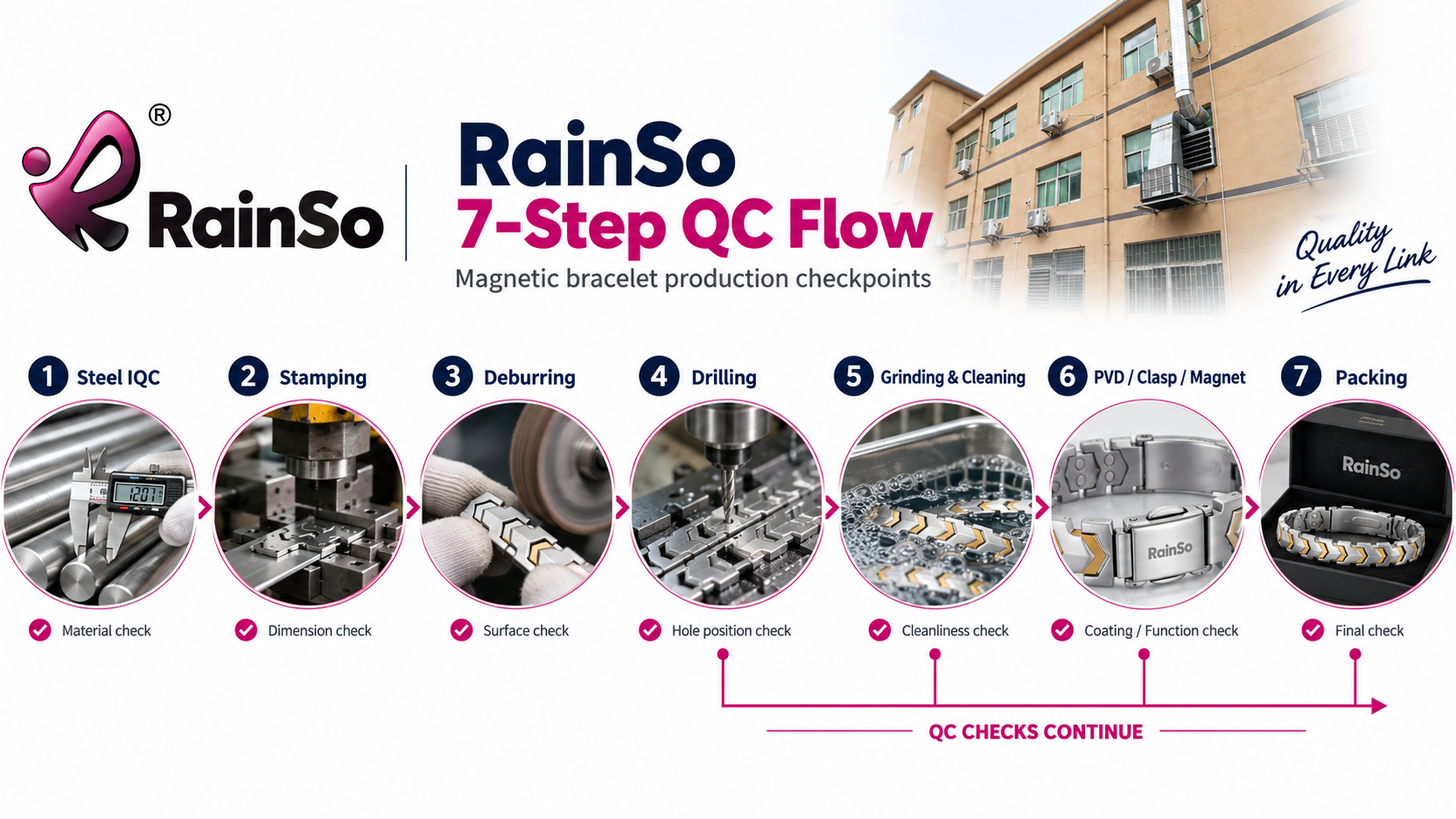
RainSo’s published QC process covers seven checkpoints:
- Incoming material check
- Pre-plating inspection
- Plating quality check
- Post-assembly inspection
- Clasp strength check
- Structure recheck
- Pre-shipment check
The exact checks depend on the product and order. A bracelet, ring, necklace, earring, or anklet does not share every clasp or structure requirement. The useful question is which checkpoints apply to your SKU, who records the result, and what happens when an item does not meet the agreed requirement.
Use the seven steps as a working framework, not a slogan. Before production, ask which checks apply, how they are recorded, and what happens if one fails.
What ISO 9001 Does and Does Not Prove
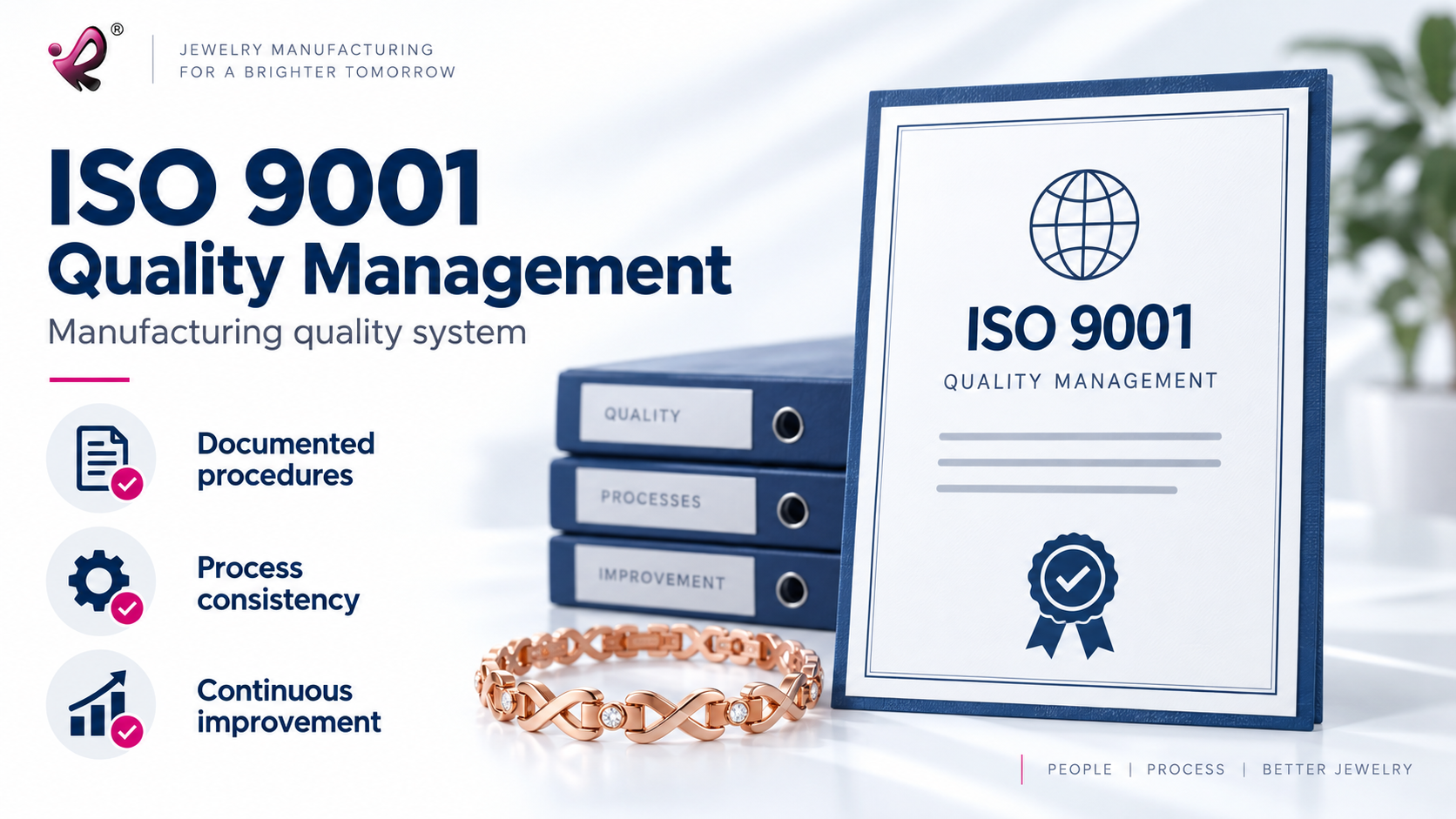
Does ISO 9001 mean a product will have zero defects? No. It supports consistent procedures, process control, and continuous improvement. It still does not replace product-specific QC records.
RainSo’s public content includes ISO 9001 Certified wording. Buyers can request the current certificate to confirm the certificate body, covered entity, activities, and validity. RainSo does not publish a certificate number or expiry on the About page, so those details should come from the document request.
What a Factory Label Does Not Automatically Prove
A supplier can call itself a factory while outsourcing part of production. It can also have in-house resources but use a weak final inspection process. A magnetic jewelry factory or trading company label is only a starting point. Production access, QC ownership, and batch records are the stronger points to verify.
Private-label and custom work makes this more important. A stock reorder may need only a simple SKU check. A custom bracelet with logo engraving, specific magnet placement, or a mixed-material finish needs direct communication with the people handling production and QC.
How RainSo’s Order Paths Support Verification
For a magnetic jewelry factory or trading company, order paths show who controls production and quality.
RainSo uses two order paths: stock wholesale and custom production. The stock path has a USD $500 mixed-order minimum. One piece per SKU can be mixed, while two pieces per style is a planning recommendation. In-stock orders normally dispatch within three business days after stock, order details, and payment are confirmed.
The custom path starts with a complete and feasible brief. RainSo provides a 48-hour initial CAD direction after that brief. Standard custom samples are generally planned within 30-45 days after CAD, material, tooling, and sample requirements are set. Private-label laser logo engraving is free from 100 units when the material, position and artwork are suitable; the exact scope is confirmed in the quotation.
Both paths require order-level confirmation. If a supplier promises custom production without asking about CAD, material, or tooling, that is a warning sign. A capable supplier should be able to explain what information is needed before quoting or sampling.
Product and Material Context for the Verification
Catalog scope is one of the easiest claims to test when comparing a magnetic jewelry factory or trading company.
RainSo’s current catalog covers bracelets, rings, necklaces, earrings, and anklets. Published material families are 316L stainless steel, copper, titanium, and ceramic. Ceramic is the current published non-metal material label. Browse the magnetic jewelry products page to review the available categories.
A defined catalog is easier to trust than a supplier that claims to make everything. It still does not answer the SKU-level questions: material, finish, and availability.
Start With a Verification-Ready Inquiry
A short, specific inquiry gets a more useful answer than “Please send price list.” Include the product category, target material, estimated quantity, stock or custom requirement, packaging or logo needs, and the documents you want to review. When comparing a magnetic jewelry factory or trading company, request the business scope, QC checklist, and current ISO 9001 scope.
When you contact RainSo, the team can confirm whether the project is stock or custom, which QC checkpoints apply, and what production documentation can be shared after any required NDA or project confirmation. Start at the RainSo inquiry page.
Frequently Asked Questions
Is RainSo a magnetic jewelry factory or trading company?
RainSo is an in-house magnetic jewelry manufacturer and B2B supplier. It was established in 2007, has a Guangzhou commercial team, and uses production resources in Dongguan. Buyers should still verify the business scope and production documentation for their specific project.
What document can confirm whether a supplier is a factory or trading company?
A business registration or supplier questionnaire can show whether the registered scope includes manufacturing, processing, production, or assembly. Buyers can also request the production site, QC records, and an explanation of how orders are traced to in-house or contracted production.
Does RainSo have ISO 9001 certification?
RainSo’s public content states ISO 9001 Certified. Buyers can request the current certificate to confirm the covered entity, activities, certificate body, and validity. The public wording does not include a certificate number or expiry date.
How can buyers check RainSo’s QC process before ordering?
RainSo publishes a seven-step quality-control process covering incoming material, pre-plating inspection, plating quality, post-assembly inspection, clasp strength, structure recheck, and pre-shipment checks. Buyers can request the checklist and record format that apply to their order.
What order information should a buyer confirm before choosing RainSo?
Confirm the SKU, material, quantity, packaging, and whether the requirement is stock or custom. Stock and custom paths follow different planning steps. Commercial terms remain subject to the quotation and confirmed order documents.