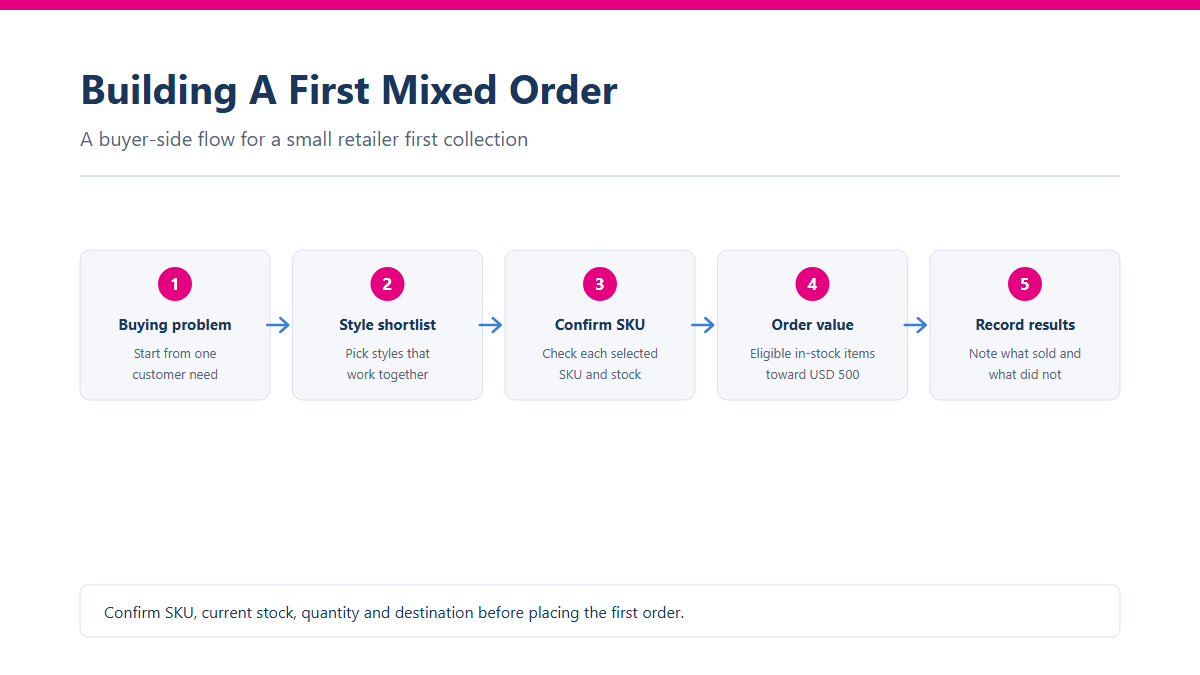
Direct answer: A first mixed order is not a small version of the full catalogue. It is a controlled test with a reason for every SKU. Start with a small list of existing styles, give each item a role, confirm SKU and stock before quoting, and decide what to do if a selected style is unavailable. Eligible in-stock items can be ordered at quantity 1 per style; 2+ units per style is a display recommendation, not a requirement. The mixed product-order value is US$500, confirmed for the selected in-stock SKUs and order scope.
On this page
Set the test objective first
A mixed order can test more than demand. It can test a category, a finish, a size range, a price position or a display idea. Write one objective for each SKU before adding it to the list. If an item has no role in the test, leave it out of the first order.
Keep the list small enough that the shop can display, explain and record every item. A first order filled with near-identical styles produces weaker feedback because the buyer cannot tell which feature or price point caused the result.
Build the first SKU list
Compare each proposed item by SKU, category, material, finish, size and display role. Separate catalogue coverage from current stock: a style can be published and still need a stock check before it is quoted.
- Core role: a familiar category that can carry a normal display position.
- Test role: a size, finish or price point the shop needs to learn about.
- Feature role: one style with a clear visual or functional difference.
- Back-up role: a substitute that fits the same role if the first choice is unavailable.
Set quantities and product roles
The policy distinction matters: eligible in-stock items can be ordered at quantity 1 per style. A quantity of 2 or more can be useful for display, but it is a recommendation, not a per-style MOQ.
| Role in the test | Starting quantity | What the buyer is checking |
|---|---|---|
| Core style | 1+ per style | Whether the category fits the shop’s customer and display. |
| Size or finish test | 1+ per variant | Which size or finish generates questions, interest or returns. |
| Feature or price test | 1+ per style | Whether the difference is clear enough to explain and sell. |
| Display back-up | 2+ if the buyer chooses | Whether a second piece improves the display; it is not required. |
Plan for stockouts and substitutes
For every selected SKU, note a substitute by role rather than by colour alone. Confirm current stock during the quotation. If the first choice is unavailable, the buyer should be told which substitute is being considered; the supplier should not silently replace a selected style. A published product page is not a stock guarantee.
How the mixed order works
Suitable in-stock SKUs can be combined toward the US$500 mixed product-order value. Use the mixed order record to keep the SKU roles and substitutes visible. The threshold applies to eligible product value for the selected order scope; freight, duties, taxes and other charges should be confirmed separately. Review the mixed order policy before sending the SKU list.
What to send with the inquiry
- The test objective and target customer.
- SKU list, quantity and the role of each item.
- Any size, finish, material or packaging preference.
- Destination market and delivery requirement.
- A substitute or an instruction on what to do if a style is out of stock.
Browse the ready-to-ship wholesale hub, the product catalogue and the bracelet collection, then use the stock wholesale inquiry path when the list is ready.
Record the order after receipt
Open the delivery against the order record, not from memory. Note the receipt date, SKU and quantity received, box condition, any damage or shortage, and photos where relevant. Then record which styles were displayed, which generated questions, what sold and which item stayed behind.
A single sold-out style is not proof that every size or finish should be reordered. Compare the SKU-level result with its role in the test. A weak result may mean the style, size, finish, display position or price point was wrong.
Choose the next step from the record
The next mixed order can deepen a style with repeat demand, test a new size or replace an item that did not fit its role. Keep the same SKU references so stock, packaging and customer feedback can be compared against the first order.
Frequently asked questions
Can a small retailer mix different styles?
Yes. Suitable in-stock styles can be combined toward the US$500 mixed product-order value, subject to stock and quotation confirmation for the selected SKUs.
Does every style require more than one piece?
No. Eligible stock items can be ordered at quantity 1 per style. Two or more pieces per style is a display recommendation, not a requirement.
What should happen if a selected style is out of stock?
The buyer should be told before the substitution is made. Use the substitute that fits the same role, or remove the SKU and revise the quotation.
What should the buyer record after the first order?
Record receipts, stock condition, display position, customer questions, sell-through and return reasons by SKU. Those notes are more useful for the next order than a general impression of the range.
For product data fields used in online catalogues, see Google Merchant Center product data specification.
Build a first mixed order around a test objective.
Send the SKU list, quantity per style, substitute rule and destination. The team can confirm stock and quotation scope.