
Direct answer: A low-MOQ jewelry collection test works when the seller can identify the SKU, prepare the listing before ordering, and compare the result by product rather than by general impression. Eligible in-stock items can be ordered at quantity 1 per style, while suitable styles can be combined toward the US$500 mixed product-order value. Confirm stock, variants, images, packaging and destination before the listing goes live.
On this page
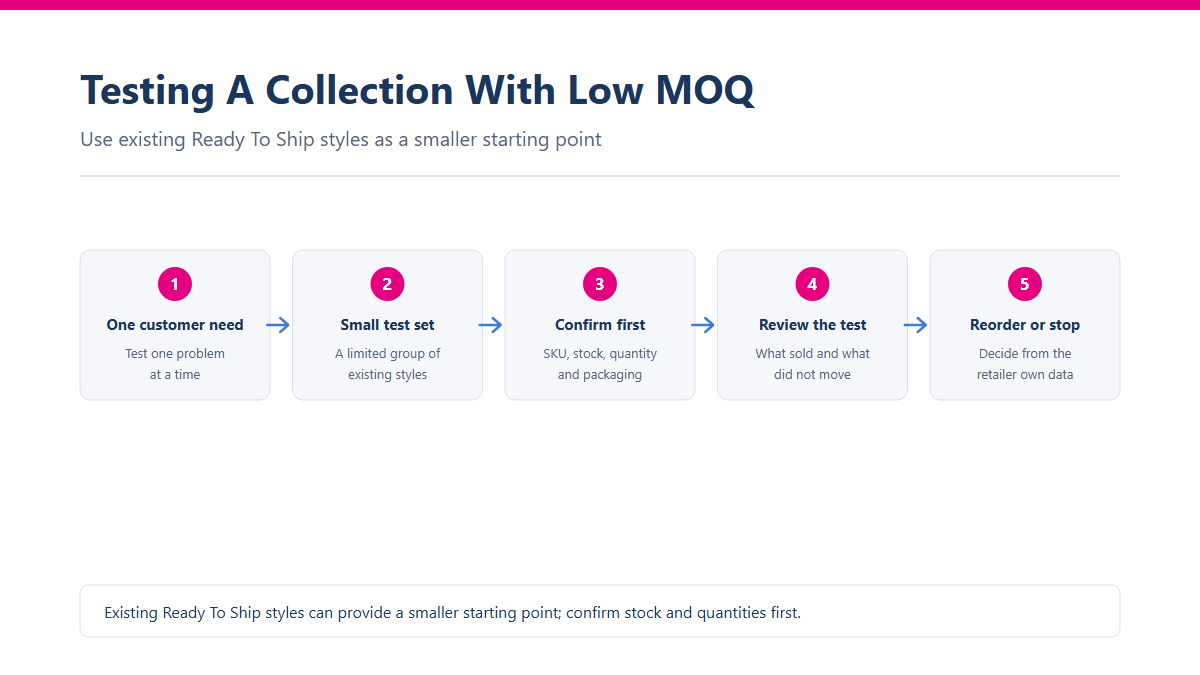
Define the listing test before choosing products
Write down the customer need the test is meant to answer: a product type, a finish, a gift use case or a price band. Choose a small group of existing styles that can answer that question. Every SKU should have a reason to be included, and the seller should be able to explain the difference between each item on the listing.
Prepare the listing before ordering
An order is easier to evaluate when the listing data is ready first. Use the same SKU reference in the order, the listing and the later review.
| Listing item | What to confirm |
|---|---|
| Product identifier | SKU, product title and variant used consistently across the order and listing. |
| Images | Approved product images, correct variant shown, image usage permission and accurate alt text. |
| Variants | Size, finish, colour or pack options that are actually available for the selected SKU. |
| Product facts | Material, dimensions, weight and care information that match the confirmed specification. |
| Shipping data | Packed weight or dimensions, shipping origin and service option used for the cost calculation. |
| Platform fields | Category, tax setting, listing fee and any destination-specific field required by the marketplace. |
| Claims and evidence | Only claims supported by the confirmed specification or the available documents. |
Design a comparable small test
Keep the jewelry test set small enough to review. If every SKU is nearly the same, the result will not show which finish, size or price point made the difference. Give each item one test role and record the question it is meant to answer.
Do not describe a test order as risk-free. It still uses working capital and the seller still has shipping, platform, return and storage costs. A low per-style quantity reduces the size of the commitment; it does not remove those costs.
Understand the quantity and order-value rules
Eligible jewelry stock items can be ordered at quantity 1 per style. Two or more pieces per style can help a display or a listing photo, but it is a recommendation, not a requirement. Suitable in-stock items can be combined toward the US$500 mixed product-order value. Final stock, price and order terms are confirmed for the selected SKUs and destination. Review the mixed order policy before sending the list.
Calculate shipping and platform costs first
Confirm the packed jewelry weight and dimensions before estimating delivery. The buyer should check the shipping service, platform fee, payment fee and return cost that apply to the destination. A product price that looks workable before fees may not work after the full landed cost is included. Keep the estimate separate from a confirmed quotation.
Review returns and customer questions
Review sales, stock remaining and customer questions by SKU. Separate a fit or listing-information problem from a quality problem. A repeated size question can mean the listing needs clearer measurements; a repeated damage issue should be investigated before the SKU is reordered. Use the same SKU references when comparing the listing result with the order record.
Set the reorder trigger
A reorder trigger should be based on evidence the seller can actually see: remaining sellable stock, recent net sales, the delivery lead time and the cost of being out of stock. There is no universal reorder quantity. Increase a style only when the result supports it, and keep a small buffer for demand variability. If a quality issue is unresolved, do not use a routine reorder to restock the same problem.
When to move to customization
If the seller needs a new structure, magnet position, size, logo or packaging format that is not part of the selected stock product, treat it as a separate private-label or custom project. Do not describe a custom change as a ready-to-ship item. Confirm the applicable MOQ, tooling and sample steps before quoting.
Browse the ready-to-ship wholesale hub and the product catalogue to confirm the current range.
Frequently asked questions
Can an online seller start with one piece per style?
Eligible stock items can be ordered at quantity 1 per style. Two or more pieces per style is a display recommendation, not a requirement. Confirm current stock and available variants first.
Can different styles be combined?
Suitable in-stock items can be combined toward the US$500 mixed product-order value. Final availability and terms are confirmed for the selected SKUs and destination.
Are all published products ready to ship?
No. Ready-to-ship refers to products in the stock range. The selected SKU, finish, size and quantity still need confirmation before the order is quoted.
What should the seller check after the test?
Review sales, customer questions, returns and remaining sellable stock by SKU. Separate a listing or fit problem from a quality problem before deciding whether to reorder.
For product data fields used in online listings, see Google Merchant Center product data specification.
Test a jewelry collection with a clearer listing plan.
Send the test objective, SKU list, variant requirements, destination and the shipping service you plan to use.