
On this page
Direct answer: Wholesale jewelry reorder planning works best when the calculation is tied to the SKU and to a defined selling window. Record opening sellable stock, receipts, gross sales, customer returns and any out-of-stock days, then use the same method across styles. The result is a planning input, not proof of future demand. For RainSo wholesale, the confirmed entry is a US$500 mixed-stock-SKU order; around 2+ units per style is a guideline, not a strict per-style stock MOQ. Confirmed in-stock orders normally dispatch within 3 business days after stock availability, order details and payment are confirmed.
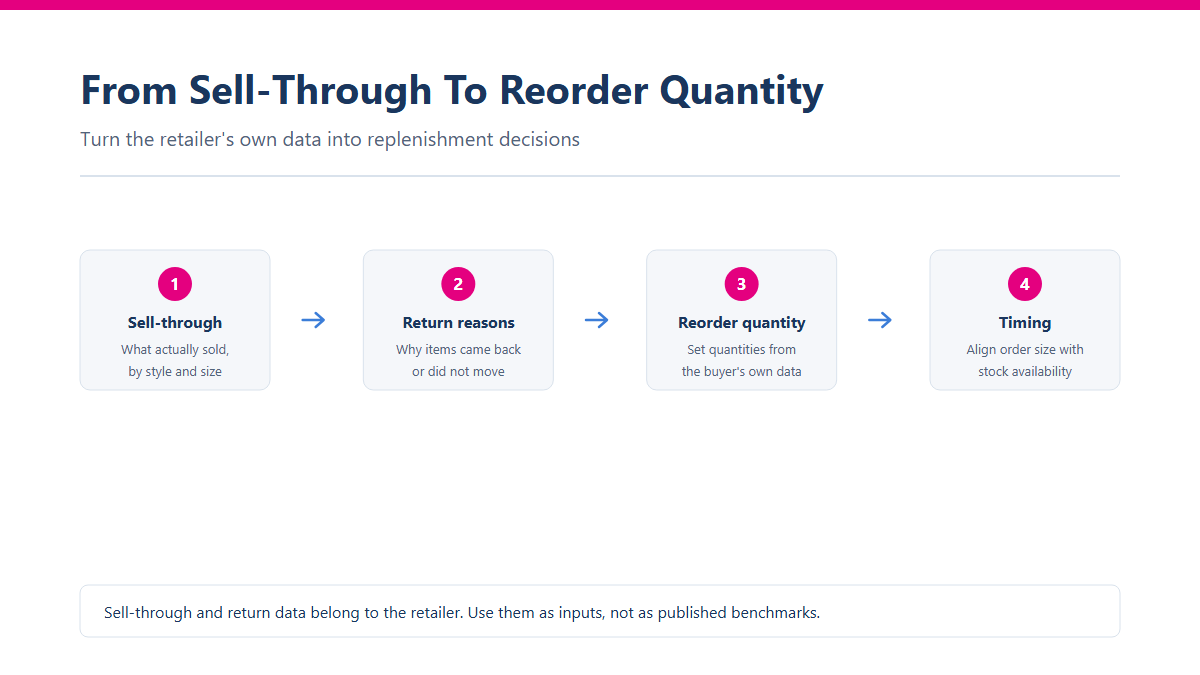
Wholesale Jewelry Reorder Planning Checklist
Use this checklist before committing to a replenishment order.
- Calculate sell-through by SKU with a written formula and a fixed review window. Use the same window across styles so the comparison is fair.
- Do not treat a launch week as a complete demand signal. Use a window that covers normal selling patterns; if only a short period is available, treat the result as provisional and check a longer period before placing a large reorder.
- Group return reasons into sizing/fit, material preference, damage/defect, style expectation, and one-off buyer error.
- Change reorder quantities only for repeat return reasons. Do not cut a style because one customer chose the wrong size.
- Confirm that the SKU still matches the current RainSo catalog categories: bracelets, rings, necklaces, earrings, and anklets, with published material families including 316L stainless steel, copper, titanium, and ceramic.
- Use the RainSo wholesale entry as a planning reference: RainSo uses a US$500 mixed-stock-SKU wholesale entry, with around 2+ units per style recommended as a guideline, not a strict per-style stock MOQ. Final stock, price, and order terms are confirmed in the quotation. See the wholesale purchasing guide for full ordering context.
How to Calculate Sell-Through with Fewer Blind Spots
For reorder work, use an operating definition and keep it consistent. Wholesale jewelry reorder planning becomes easier to compare when every SKU uses the same fields. The fields below make the result easier to review than a single percentage with no context.
| Field | What to record |
|---|---|
| Opening sellable units | Units available to sell at the start of the window, excluding damaged or quarantined stock. |
| Units received | Sellable units received during the window, including replacement stock. |
| Gross units sold | Units invoiced or dispatched during the window before customer returns. |
| Customer returns | Units returned during the window, with a note on whether they can re-enter sellable stock. |
| Closing sellable units | Sellable units left at the end of the window, excluding units in transit or under quality review. |
| Out-of-stock days | Days the SKU could not be sold because no sellable unit was available. |
Working formula: net units sold = gross units sold − customer returns. Units made available = opening sellable units + units received. Sell-through = net units sold ÷ units made available.
Example only: a style opens with 40 sellable units, receives 20, sells 36, has 3 returned units placed back into sellable stock, and closes with 27. Net units sold are 33, units made available are 60, and sell-through is 55%. This is an arithmetic example, not a RainSo sales figure or a target.
Record stockout days as well. A high sell-through rate during a stockout period can reflect missing inventory rather than stronger demand. When comparing styles with different stock coverage, use net units sold per available selling day before making a reorder decision.
Turn Sell-Through Into Reorder Quantities
Use a spreadsheet by SKU and keep the calculation visible. The spreadsheet is the working record for wholesale jewelry reorder planning, so avoid hiding the formula in a separate file. The starting reorder need is expected net sales during the next review period, plus a display and availability buffer, minus current sellable units and minus units already in transit. Keep damaged or quarantined units separate rather than counting them as available stock. If a style is not clearing, do not reorder it just to fill a display slot.
Use return reasons to adjust the mix, not the whole category. If a style has repeated sizing returns, change the size curve before changing the style. If one material family has a repeat issue, investigate the cause before placing a routine reorder. A return may reflect fit, presentation, a one-off buyer error, or a quality problem; the response should depend on which pattern is actually repeating.
Use the current product catalogue to check actual category and material coverage. Do not assume a substitute shares the same fit, finish or customer response.
Turn Return Reasons Into Action
- Sizing/fit: change the size mix, not necessarily the style.
- Material preference: shift reorder weight toward the material family winning in your own return and sell-through data.
- Damage/defect: review the order documents for the applicable claim period and contact RainSo wholesale before reordering the same SKU.
- Style expectation: adjust display or product presentation first; reorder only if the confusion is internal and correctable, not a buyer preference signal.
Set Timing and Order Size Without Overbuying
Confirmed in-stock orders normally dispatch within 3 business days after stock availability, order details and payment are confirmed. Carrier transit time is separate and depends on destination and shipping method. Build the cover period from supplier dispatch, transit, receiving and a safety buffer; do not count units already in transit as available today.
Place a reorder when sellable stock is expected to run out during that cover period. Estimate demand from net units sold per available selling day, then test a small safety buffer. For a general reference on measuring product sales in analytics, see Google’s ecommerce measurement guide. There is no universal number of weeks or units; the buffer should reflect demand variability, lead time and the cost of being out of stock.
If a quality or defect issue is still unresolved, separate the affected SKU and resolve its disposition before using routine replenishment to restock it.
For a mixed-stock replenishment quote based on your own review, Request wholesale pricing.
Keep the same wholesale jewelry reorder planning record for the next review, then browse the ready-to-ship wholesale hub to review current designs, then send the SKUs and quantities that passed your sell-through review. The wholesale ordering FAQ explains the current ordering terms.
Frequently Asked Questions
How do I calculate sell-through for wholesale jewelry reorder planning?
Set a fixed window and record opening sellable units, receipts, gross sales, returns and closing sellable units by SKU. A simple operating formula is net units sold divided by units made available. Also note out-of-stock days, because a return rate or sell-through rate without stock coverage can be misleading.
Should I reorder a style that has returns?
Only after the return pattern is understood. Separate fit, material, presentation and one-off buyer errors. If damage or a defect is unresolved, quarantine the affected SKU and resolve the issue before placing a routine reorder. For correctable patterns, adjust the size curve, material mix or presentation rather than restocking the same problem unchanged.
What is the RainSo wholesale reorder entry?
RainSo uses a US$500 mixed-stock-SKU wholesale entry. Around 2+ units per style is a planning guideline, not a strict per-style stock MOQ. Final stock, price, and order terms are confirmed in the quotation.
How fast do confirmed wholesale reorders dispatch?
Confirmed in-stock orders normally dispatch within 3 business days after stock availability, order details, and payment are confirmed. Carrier transit time is separate and depends on destination and shipping method.